Alphabet soup for the soul Vol.2 -“A”

A is for Altruism

“Every man must decide whether he will walk in the light of creative altruism or in the darkness of destructive selfishness.”       – Martin Luther King Jr.-  

Acts of kindness. Helping others without expecting anything in return. I believe this is inside the hearts of all humans, and only fear, scarcity or lack can stop this innate desire.

“Many hands make light work” and ” it takes a village” are sayings passed down since ancient times and still ring true today.

They resonate because these maxims are not unique to a moment in history or a particular culture but apply to the entire species of humans. The same holds for Altruism.

The desire to help others is ingrained inside every person on Earth; it is wired into our DNA. There is a reason it feels good to be kind to others.

Holding a door open for someone else or helping an old lady to cross the road. A friendly smile or a warm embrace. All of these actions show love and not fear.

Because all these things are done from a state of love, they also make us feel great. By doing kind acts for others, we are showing love to ourselves.

The best part is that doing things to uplift those around us can almost always be done for free. So, you do not need money to be altruistic.

These thoughtful and caring acts can be done for anyone, regardless of their rank or status.

Altruism is suitable for all people, but especially for anyone suffering from pain. We are not stuck in our headspace when we take the attention off ourselves and put it onto others: our focus has shifted, and so will our environment, perception, and reality.

Since we know what we focus on expands, Altruism allows us to expand our focus toward others. In turn, we stop the mental suffering that is taking place inside of us.

When humans suffer, it is because the mind has taken over, and all attention, thought patterns and focus are narrowed inward on the self. Altruism is selfless, meaning less about the self and more about others. In helping others, we truly do help ourselves.

Today, I challenge you to do a random act of kindness for another. What will naturally follow is that you will be more connected and not separated. Gratitude will flow, and healing will begin to take place inside you.

Click here to read B is for Belief
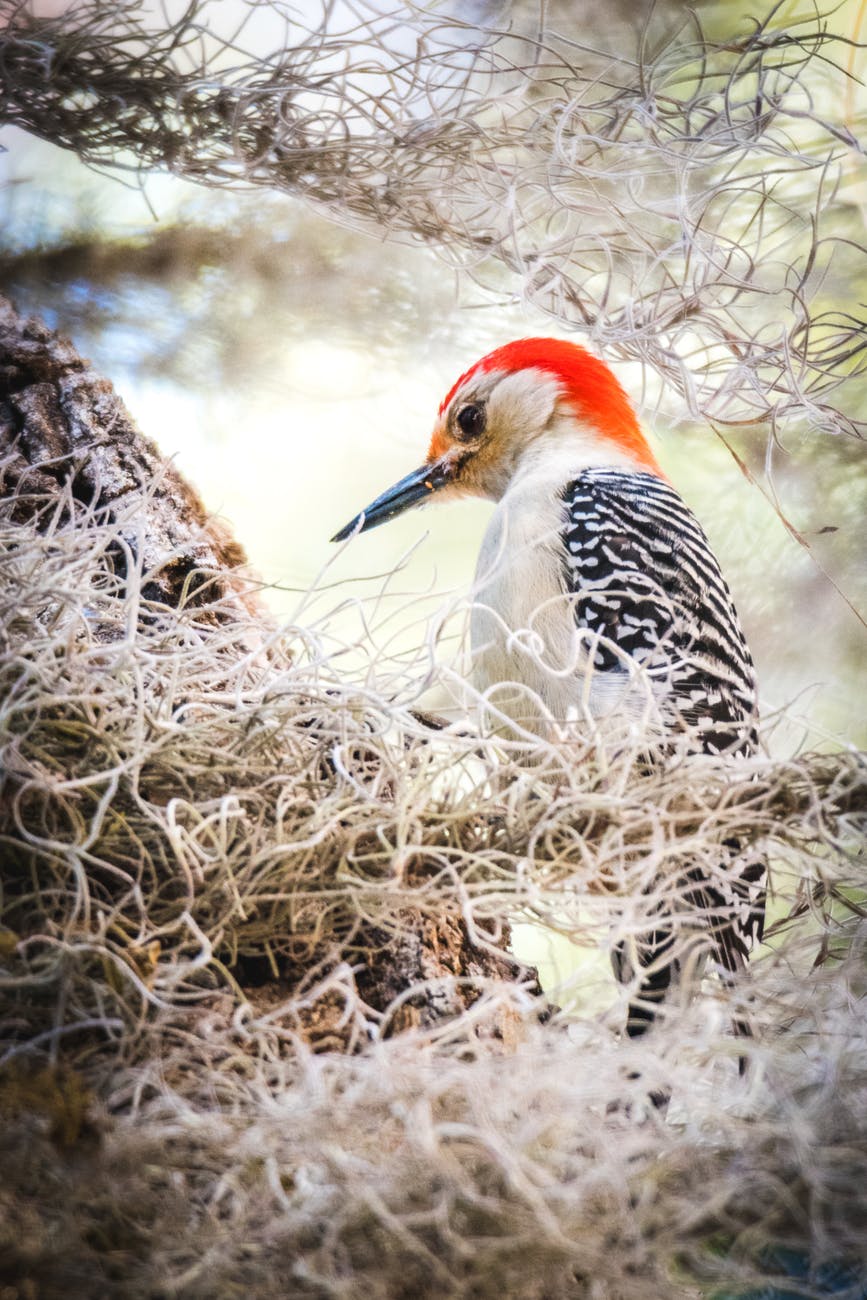
Birds from Walden Woodpecker

Even without being seen, woodpeckers are one of the most identifiable birds from the sounds they make.

The woodpecker loves the forested areas for hollowing out trees.

The Woodpecker is another beautiful, rare and unique bird.

These birds do not get headaches. Nature has designed the biology of a woodpecker so that the back of its tongue wraps around its brain, thus preventing concussions.

Seen throughout the year at Walden Pond, the woodpecker loves to peck wood.

This bird comes in many different colours and patterns. Some have red heads and a red stripe that goes down the back of their necks, while others have red on the head.

Some have a cascading black and white wavy pattern, while others have black spots over a white coat.

They all have a long, hard beak, which allows for constant penetration of dead wood.

Many types of woodpeckers can be seen and heard daily around Walden.

This brings an end to the Birds from Walden series.

Please click here to read 12 steps to a spiritual awakening!

Birds From Walden Double-crested Cormorant

The double-crested cormorant is a unique bird. It is so rare that I had never seen one before a couple of days ago.

The bird landed on the pond, and although it swam around like a Duck, I knew it wasn’t.

 I saw a long beak that reminded me of a blue heron, but it was only smaller. The difference is that herons have long legs and tend to walk around the water’s edge for food.

This bird, however, would ‘duck’ under the water and come up with some food to eat. It may have been a frog, fish or plant; I could not tell.

I observed the bird getting tangled in the weeds and almost drowning.

It was sailing around for quite some time, elegantly and entirely in control, until it got tied up.

Immediately, it started squirming and panicking.

It seemed like it would drown, and I quickly took off my shoes and socks to save it.

The bird was gone when I was ready to jump in. With a heavy heart, I thought the bird had drowned in front of my very eyes.

Seconds later, the bird reappeared fifty feet from where I last spotted it.

The bird kept going under the water and coming back up, swimming back and forth, trying to shed itself off the weeds wrapped around its wings.

Although the bird stopped squirming and looked like it had regained control, I could see the grassy weed trailing behind it like an untied shoelace following along awkwardly.

I knew the bird could not fly like this, and it seemed uninterested in making it to a piece of land to do the edge walk characteristic of the heron.

What to do? How to help?

Some things might happen if I got inside the kayak and paddled towards it. One, it would panic, and I could grab and untangle it; two, it would forget that it was trapped and fly away furiously.

It was the former and not the latter that ended up happening.

As I paddled toward the bird in a game of cat and mouse that lasted almost an hour, the bird would duck under the water and reappear elsewhere.

One of the times the bird went under, it came up without the weed. 

With my part in the rescue complete, I took the kayak out of the water and retreated to the edge of the woods to watch this beautiful bird wade in the water.

The bird tried to fly away but only got 20 feet before landing on the water again.

I was unsure if the bird was still impaired, or perhaps it was a baby (a considerable baby) just learning to fly and did not yet know how to travel at height or distance.

The bird decided to get out of the water and sunbathe on the dock. The way the birds basked in the sun was remarkable and angelic.

In an attractive display of beauty rarely seen, it would open its wings to dry off and, in doing so, puff out its chest, suggesting strength and grace simultaneously.

It reminded me of the American Eagle on the U.S. dollar bill.

It was gone as quickly as it appeared. It was moving on to the next pond or pasture. It didn’t make a noise like the Canada geese when it flew, but like the ones we loved the most that have moved on, its beauty remains long after its departure.

Click here for Wood-pecker

Birds from Walden Blue jay

Bluejays can be seen in the Northeast of the U.S. and Canada for winter, even though they are also in places like Florida.

They are beautiful, bright blue birds strikingly different from each other. There are skinny ones, fat ones, tall ones, short ones, and young and old ones.

They are a tight-knit group and often flock together, descending upon birdhouses en masse.

Although they look pretty and cute, these birds squawk loud like crows and seem aggressive towards other bird species.

At times, these birds are even aggressive to other Bluejays. 

Bluejays are too big for most feeders, and when they sit on the smaller feeders’ perches, their wings start flapping as they try to get the food out. Realizing their dilemma, they will defer to the open-concept birdhouse instead.

I have been fortunate enough to see a bluejay pair appear, and within a minute of their arrival, another dozen swoop in for a snack—bluejays numbering Fourteen frolics and forage for food.  

 These birds’ colours look extraordinary, especially against a white winter snowy morning.

The brightness of this bird is paralleled around Walden only by the Cardinal, Goldfinch and Oriole.

Click here for Double-crested Cormorant

Photo by Jack Bulmer on Pexels.com

Birds from Walden American Eagle

Decades after witnessing the tragic events of September 11th, we honour the lives lost with this article about the American Eagle.

The American Eagle is one of Earth’s most unique and powerful animals. Its hunting skills and ferocity make this predator number one among birds.

Gliding far above any food it wants to catch, It can drop undetected. In flight, entertainment consists of swooping in at thirty to fifty miles an hour (on a side note, a peregrine falcon can travel at speeds of 200 mph)

It can spot its prey from over a mile away. With an average wingspan of 5-8 ft, Eagles can sail effortlessly above anything.

The Bald Eagle is stealthy enough to swoop undetected to pluck fish directly out of the water.

With talons that cut through and grip its prey, this bird represents true power, yet it is so elegant and smooth in flight.

 A symbol is so powerful that it is seen on the American quarter, silver and half a dollar. It is also found on every bill (except Thomas Jefferson on the $2).

It can be found by looking at the one-dollar bill on the opposite side of George Washington. It almost touches the faces of Abraham Lincoln, Alexander Hamilton, Andrew Jackson, Ulysses S. Grant and George Washington, respectively, as we move up to the one-hundred-dollar bill.

Steeped in the history of America, it has been woven into the social fabric and was placed on a copper penny as early as 1776. It is a visual imprinted on all Americans and immigrants alike. It is seen in every airport and most government seals.

It is the main focal point of the United States Presidential Seal, the most recognizable symbol that branches worldwide to symbolize strength, ferocity and elegance. These are just a couple of core values that America delivers to the world.

Lest we forget – 9/11 and all its heroes!

Click here for Bluejay

Birds from Walden Ducks

Ducks are another phenomenal species of bird.

They are great parents and stay with their young all day and night. They will travel up and down rivers, streams and lakes with their entire ‘school’ of children.

They can often be seen in the early morning hours travelling single file, on land or water, in lines and rows stretching longer as the numbers grow.

I have noticed that in the lakes and streams around Walden, it is not one adult duck with a baby or two; instead, there seems to be a large family containing five or six adults and up to thirty chicks at a time.

Projecting caution at all times to protect their young, these Male and Female Ducks share the workload.

I have been fortunate enough to witness the chicks following orders to jump in the water individually while the adult leads from the front. Then, another adult will stand at the water entrance, counting to ensure all the ducks are there.

This reminds me of being a young lad and going for walks with the class at school, where the teacher would continuously do a headcount.

There is a saying, “Like water off a duck’s back.” This means that if you stay well-oiled with love and light, then if there is anything wrong that life throws at you, you can let it hit you and then roll right off of you without the impact of crushing you or defining you.

Ducks are known to be great swimmers. Ducks look serene and appear to be floating calmly on the water when you see them. You can’t see the Duck’s feet paddling hard under the water.

This is an excellent metaphor for action. Take action and work hard toward your goals, but do not talk about the problematic parts of the journey. Just smile and flow along with the water of life.

Click here for American Eagle

Birds from Walden Grackle

The Grackle has an iridescent blue silk head on a smooth black body. Although this bird is freaky looking, it is also excellent.

Grackles appear to reverse their colour schemes from the time of babies, with blue on the body and black (or brown) around the head.

Although they look mean and scary, they are considerate to the other birds around the feeder and can often be seen patiently waiting for their turn.

Unlike some species that will scare off the little birds, the grackle has surprising, surprising, big-brother-like qualities.

Not shy, the grackle will let us know when we have breached its safety and comfort zone. This observation was made apparent when I entered his space from inside a kayak and got a little too close to the nest.

The bird, protective as any parent, tried thwarting my attention as it flew away from the nest to get me to follow.

Armed with the realization that this was happening, the next move gently to paddle away from the nest.

Studying the grackle is a good lesson: “Don’t judge a book by its cover.”

Personally and metaphorically speaking, these birds have transformed from the ugly caterpillar into the beautiful butterfly in the attachment of my mind.

Click here for Duck

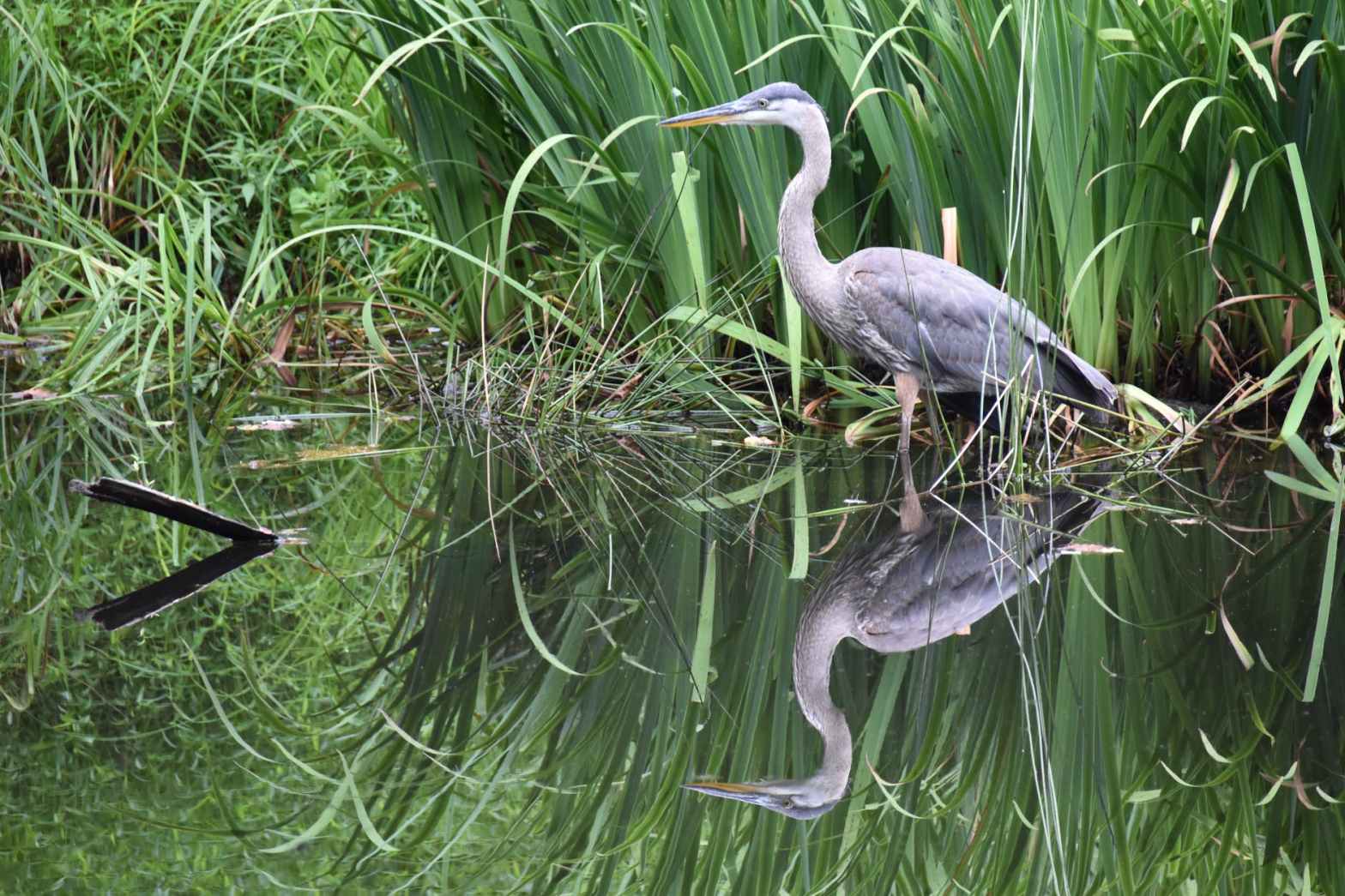
Birds from Walden Blue Heron

Blue heron

This beautiful bird can be found at the pond’s edge, often sneaking through the long grass in search of frogs. 

The heron stands tall and straight in its posture, helped by its long legs. Slow to move unless it has to.

Colours of a purple-ish grey-blue separate the majestic-looking creature from similar typed birds such as osprey and flamingos. 

This giant bird has a massive wingspan and looks elegant and cumbersome while trying to take off. 

It furiously flaps its broad wings, barely clearing the treeline as it flies away in an upward path that does not allow much leeway for mistakes.

At times, it will fly through the tree branches because it can not clear the treetops, yet it still manages to avoid crashing into the leaves. 

Always making seemingly hard work look easy, the heron eventually reaches full stride, at which point it looks effortless. 

Over time one particular Heron has learned to exit the pond on the opposite side, thus giving it more ‘runway’ to chart a better flight pattern similar to the Canada geese.

The heron bird is a rare treat and, if left undisturbed, can be watched for hours.

In the early morning hours, not far from Walden, the great blue heron can be seen flying just a couple of feet above the water. It is sailing across the lake on its way to the next adventure.

It will play in one pond and then another as it travels around the neighbourhood, always returning for a swim at Walden Pond.

Recently, I spotted a heron at the edge of a pond and a deer beside it. They were not in competition or hunting each other; instead, they looked like a pair of little boys fishing as the sun started to rise behind them in the early hours of another humid summer morning!

Click here for Grackle

Birds from Walden Cardinal

Cardinal

Like the Robin, The Cardinal is another bird that is a powerful symbol.

This radiant red bird portrays perfect symmetry. Most commonly seen with a stylish spikey haircut on the top of its head, a head that is a brighter red than the rest of the body.

Sporting an orange beak, the rest of its face is covered by a black mask to protect it from the sun, identical to most Goldfinches.

The Cardinal’s head is a more solid red than the rest of his body, which has a touch of grey, looking like a painter’s purposeful brushstroke blended it deep into the red. 

Somehow, through the striking redness,  these birds seem to disappear into the green canopy of the bushes.

I often spot a pair in the forest frolicking for fun. The teams are similar and different at the same time. One is the standard red Cardinal that was described already. The other is grey or the Northern Cardinal with a tinge of red, identifiable as a Cardinal because of the signature black mask, orange beak, and spikey hair-do.

There is also a short, stout red Cardinal around Walden Pond, and this particular bird does not have spikey hair. However, the day I spotted this one, there was significant rainfall, so it is possible that it was wet.

The Cardinal makes a unique noise consisting of four fast, short tweets followed by three longer, slower ones.

Like the Oriole and the Blue jay, the red Cardinal brings a colour not native to the green tree lines and bushes, providing a rush of colour to Walden’s wildlife.

Click here for Great Blue Heron

Birds from Walden Goldfinch

Goldfinch

The Goldfinch is one of the brightest, most colourful birds that frequent the gardens and bird feeders around Walden. Finchs are seen throughout the summer in the northeast. 

These miniature birds are yellow with black markings (almost like a small yellow oriole). Sometimes, they are green and look as if they are wet, even though they are not. 

They travel in packs and will most often be seen flocking a feeder together in numbers of four or five at a time. 

If there is safety in numbers, there is also beauty in numbers, as a group of goldfinches together will radiate remarkable sharpness and vivid, deep detail. These little birds tend to stick together because, in their world, there truly is safety in numbers.

If you are fortunate, you may witness blue finches. The same small bird but blue. The blue finch is another wondrous sight to behold.

As far as flying, they are not the best. The birds go forth in 10-20 foot spurts and then drop before pushing on again in an elevated struggle to travel further. The distance is covered in sections instead of a smooth sail like the red-winged blackbird or the soft glide of a grackle.

Personally and selfishly, these are some of the most delightful birds to watch.  Their bright yellow colour is only made sharper by the black cardinal-like mask over their face, protecting their eyes from the sun that shines as bright as the Goldfinch. 

Click here for Cardinal